Introduction:
Canada’s manufacturing sector is vital to the economy, accounting for nearly 10% of GDP and employing about 1.7 million people. Yet manufacturers are facing acute skilled labor shortages and complex HR compliance challenges. In recent years, over 80% of Canadian manufacturers have reported labor and skills shortages, with 62% losing or turning down contracts due to lack of workers – an issue that cost an estimated $7.2 billion in lost sales and penalties in one year. At the same time, manufacturers must navigate a maze of federal and provincial employment laws, safety regulations, and payroll obligations. These twin pressures of talent gaps and regulatory compliance can hinder growth and competitiveness.
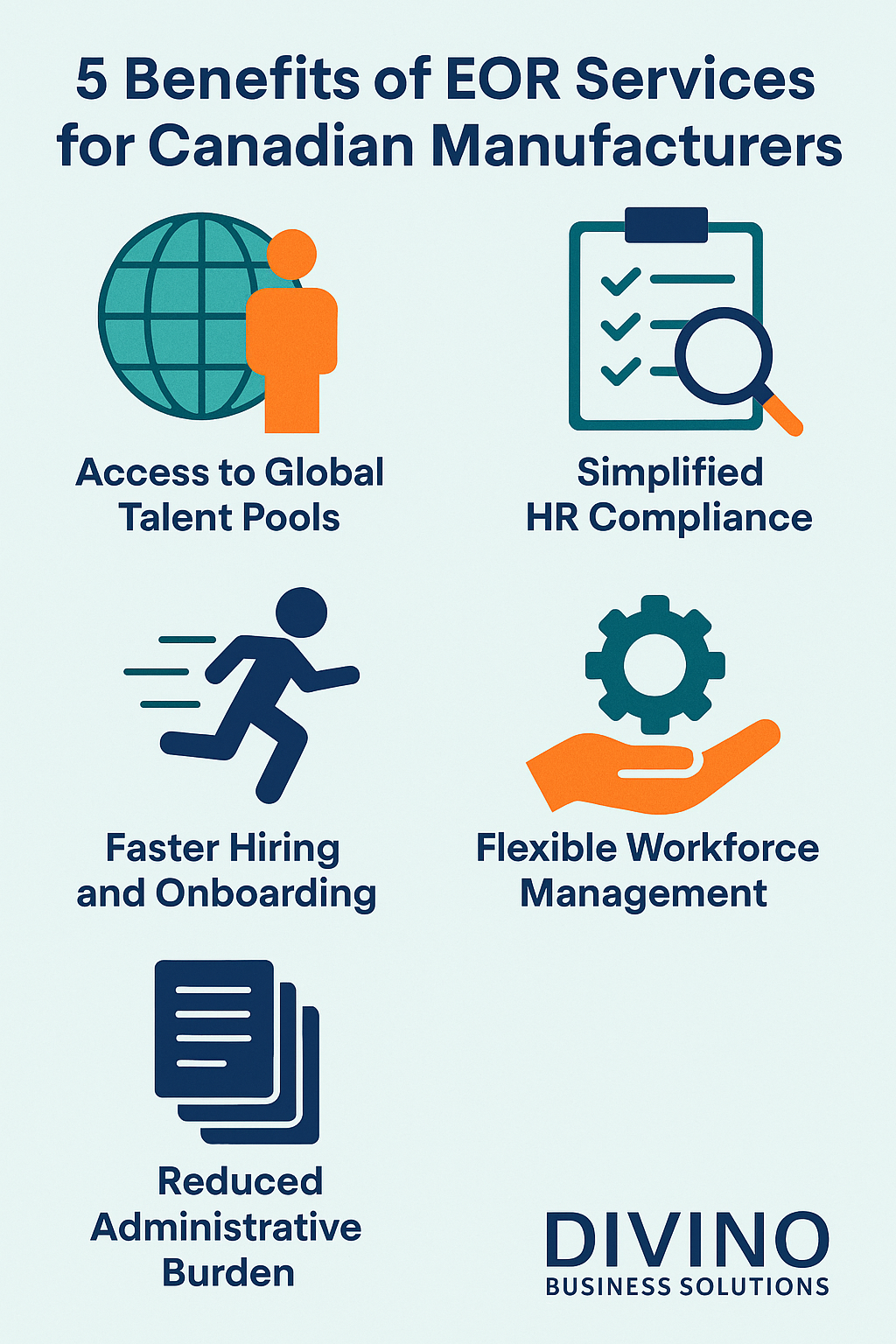
One strategic solution gaining traction is partnering with an Employer of Record (EOR). An EOR is a service provider that hires employees on your behalf in a target region, handling all employment formalities – from contracts and payroll to taxes and legal compliance – while you direct the day-to-day work. For Canadian manufacturers, utilizing EOR services can address skilled labor shortages by opening access to global talent and simplify HR compliance by offloading the burden of regulatory management. Here are five key benefits of EOR services for manufacturers in Canada:
1. Access to Global Talent Pools to Fill Skills Gaps
Skilled trades and specialized technical roles are increasingly hard to fill in Canada’s manufacturing industry. A wave of retirements among an aging workforce and a shortage of younger tradespeople have left thousands of positions open. In fact, industry surveys indicate there are over 85,000 vacant positions in manufacturing that need to be filled. An EOR can help close this gap by enabling manufacturers to tap into global talent pools beyond Canada’s borders.
With an EOR as a partner, a company in Ontario or Quebec, for example, can recruit a highly skilled engineer from Europe or a technician from Asia without needing to set up a foreign subsidiary or navigate international hiring laws alone. The EOR becomes the legal employer for the worker in their home country or in Canada (if relocating), handling work permits, employment contracts, and local labor law compliance. This allows manufacturers to hire the best talent available worldwide to meet critical skill needs, whether it’s for advanced CNC machining, automation programming, or plant management expertise.
By thinking globally, Canadian manufacturers can overcome domestic talent shortages. The EOR manages the legal and logistical hurdles of international hiring – such as visa sponsorship, tax withholdings, and regional employment regulations – making it seamless to onboard skilled workers from abroad. As Globalization Partners notes, manufacturers can use EOR services to quickly fill skills gaps by recruiting worldwide, while the EOR handles all the cross-border complexities. This broad access to talent not only addresses immediate shortages but also brings in diverse expertise that can drive innovation in the company.
Moreover, an EOR often provides market insights on hiring in different regions, such as typical salary ranges or talent availability, helping manufacturers make informed decisions about where to source the skills they need. In a competitive talent landscape, this global reach is a game-changer. Instead of being limited to local applicants (when many firms are fishing in the same small pond of skilled trades), manufacturers using an EOR can cast a wider net and bring in qualified welders, electricians, engineers, or quality controllers from virtually anywhere, quickly and compliantly.
Real-life example: One notable case is AmbioPharm, a manufacturing company in the biotech sector, which needed to hire specialized talent across multiple countries to support its growth. By partnering with an EOR, AmbioPharm was able to create region-specific employment contracts and onboard top talent in different countries rapidly and in full compliance with each locale’s laws. The EOR handled all paperwork and regulatory requirements, enabling AmbioPharm to bridge critical skills gaps and expand its global operations smoothly. This example illustrates how an EOR can empower manufacturers to acquire skilled workers from around the world, overcoming local labor shortages.
2. Simplified HR Compliance and Risk Mitigation
Navigating HR compliance in the manufacturing sector is daunting, especially in Canada where federal and provincial laws intersect. Manufacturers must comply with a host of regulations: provincial employment standards (covering minimum wage, overtime, vacations, termination notice, etc.), federal labor laws for any interprovincial operations, health and safety regulations (such as OSHA/COSHA and province-specific safety codes), mandatory benefits like CPP and Employment Insurance, and privacy laws (PIPEDA) related to employee data. Keeping up with frequent changes – for example, new leave policies or minimum wage updates in different provinces – requires constant monitoring and expertise. Non-compliance can lead to severe penalties, legal disputes, or reputational damage.
One of the prime benefits of using an EOR is that it takes on the responsibility of compliance with all employment laws and greatly reduces legal risk for the manufacturer. The EOR becomes the legal employer of record, which means it is accountable for adhering to labor regulations on all fronts – they draft employment contracts that meet local laws, with the correct clauses for things like overtime and termination; they ensure all required statutory benefits are provided; they handle payroll tax withholdings accurately and on time, and they maintain compliance with workplace safety rules across jurisdictions. Essentially, the EOR’s job is to be the expert on local HR compliance, so your company doesn’t have to be.
For Canadian operations, a good EOR will continuously monitor and ensure compliance with ever-changing labor laws, tax rules, and employment standards in each province. This proactive compliance management means the manufacturer can avoid the headache of tracking regulatory updates or fearing inadvertent violations. The EOR keeps your employment practices up-to-date with current laws – whether it’s a new statutory holiday, updates to occupational safety requirements, or changes to pension contribution rates – and implements those changes seamlessly for your workforce.
Crucially, partnering with an EOR mitigates risks such as fines or lawsuits. By relying on compliance specialists, manufacturers reduce the chance of costly errors in areas like worker classification, overtime pay, or termination procedures. For example, Canadian provinces have strict rules on termination notice and severance pay; an EOR in Canada will ensure that if you need to offboard an employee, all notice periods and payouts are handled in line with provincial legislation, protecting you from wrongful dismissal claims. Similarly, in a field like manufacturing with stringent safety standards, an EOR helps enforce local health and safety training and guidelines for your employees, creating a safe and legally compliant workplace.
In short, the EOR acts as a shield against regulatory pitfalls. HR compliance is simplified for your company – you receive the assurance that all the “i’s” are dotted and “t’s” crossed in the realm of labor law, without having to build that expertise internally. As a result, you can focus on production and quality, rather than pouring over employment codes. This benefit cannot be overstated in a heavily regulated sector: by outsourcing compliance to an EOR, Canadian manufacturers can operate confidently knowing that everything from employment contracts to payroll taxes is handled according to the law. The peace of mind and legal protection this provides is a major advantage of the EOR model.
3. Faster Hiring and Onboarding (Rapid Market Entry)
Time is of the essence when you have orders to fill and a talent gap to close. Traditional hiring, especially in a new province or country, can be a slow process mired in administrative delays – registering a local entity, setting up payroll accounts, and waiting on various approvals can take months. Meanwhile, production might be waiting on that key specialist or a plant can’t run a new shift because staffing isn’t in place. EOR services dramatically speed up the hiring timeline, allowing manufacturers to bring new workers on board in a fraction of the time it would normally take.
With an EOR, a company expanding into Canada or simply adding staff in another province can avoid the lengthy entity setup and registration process. Manufacturers can hire and onboard employees in as little as a couple of weeks through an EOR, compared to potentially 3–6 months to establish a subsidiary and ensure compliance on your own. For example, Safeguard Global notes that using an EOR provides a “streamlined pathway to market entry,” making it possible to start employing workers in Canada within one or two weeks – without needing to establish a legal entity. All the bureaucracy of setting up a new business location (incorporation, tax IDs, provincial registrations, etc.) is bypassed, because the EOR’s local entity is already in place and operational.
This rapid onboarding is invaluable for manufacturers facing urgent labor needs. If you receive a large order that requires ramping up production next month, you can’t afford a six-month delay to hire additional staff. With an EOR, you could quickly onboard a group of skilled machinists or assembly technicians in a matter of days or weeks, so they can start training and work almost immediately. The EOR handles drafting the contracts, enrolling them on payroll and benefits, and all requisite new-hire paperwork behind the scenes, while you integrate the workers into your operation.
Furthermore, EORs often have established HR infrastructure and expertise in onboarding, which means new employees experience a smooth entry. They ensure that offer letters, confidentiality agreements, and tax forms are all properly executed. Many EORs also assist with background checks or required medical/work eligibility checks if needed. This level of support not only accelerates the time-to-productivity for new hires, but also creates a positive first impression on employees who see a well-organized onboarding.
For global hires, the speed benefit is equally prominent. If a manufacturer decides to hire a specialized technician from overseas, an EOR can navigate Canada’s work permit process (such as through the Global Talent Stream for high-skilled workers) much faster and more efficiently than the company likely could on its own. They know the fastest legal pathways and have experience with immigration formalities, which can significantly reduce waiting times to bring that foreign employee on board. In summary, an EOR allows Canadian manufacturers to scale up their workforce quickly and seize opportunities without being slowed down by red tape.
4. Flexible Workforce Management and Scalability
Manufacturing is a dynamic industry – production levels ebb and flow with market demand, seasons, and project cycles. Canadian manufacturers often need flexibility in adjusting their workforce size or composition. For instance, a company might require an extra 50 workers for a big contract this quarter, then only need 20 the next, or they might want to pilot a project in a new region without committing to a permanent operation. Handling such fluctuations can be challenging if every hire and layoff has to go through rigid corporate and legal procedures. This is where an EOR provides tremendous value by enabling agile and scalable workforce management.
Through an EOR, manufacturers can expand or contract their workforce quickly as needed, without the usual complications of direct employment. Because the employees are officially employed by the EOR, adding a new hire is as simple as a service request to the EOR – you don’t have to set up a new entity or permanently increase your internal headcount. Similarly, if a project ends or demand dips, transitioning an employee off (or reducing hours) is administratively smoother via the EOR, who manages the termination process in compliance with local law. This agility means you can staff up for a short-term project or surge in orders and then scale down with far less risk and effort than if you had hired everyone directly onto your payroll.
EORs also make it feasible to engage contractors or temporary specialists in a compliant way. Many manufacturers use contractors for niche expertise or maintenance shutdowns, but misclassifying a worker or not following provincial temp worker regulations can be risky. An EOR can act as the contractor’s employer, ensuring even short-term engagements are handled according to regulations. For example, if a factory in Alberta needs specialized welding contractors for a 3-month facility upgrade, an EOR can quickly onboard those workers under short-term contracts and make sure all tax deductions and safety training are in place for the duration of their work. When the project is done, the EOR smoothly offboards them. This allows the manufacturer to flexibly plug skill gaps on demand without long-term commitments or legal exposure.
Scalability is another facet of flexibility. If a Canadian manufacturer is testing a new product line or exploring a new export market, they might want to hire a small local team in another country to see how it goes. Doing this through an EOR means the company can “test the waters” in a new market by hiring a few employees there, with minimal investment. If the venture is successful, they can scale up quickly by adding more staff via the EOR. If not, they can withdraw without the burden of having set up a whole foreign subsidiary. The ability to pivot and scale operations up or down with EOR support gives manufacturers a competitive edge – they can respond to market opportunities or downturns faster than competitors who are tied to more inflexible hiring models.
In essence, EOR services offer manufacturers much-needed flexibility in managing human resources. You gain a variable workforce that can be adjusted in almost real-time to match business needs, all while the EOR ensures every change (hiring, hours changes, layoffs) is handled lawfully and efficiently. This level of scalability is crucial in manufacturing, where the cost of under-staffing is lost revenue and the cost of over-staffing is wasted payroll. The EOR helps strike the right balance by making workforce adjustments painless and compliant.
5. Reduced Administrative Burden and Focus on Core Operations
Running the HR side of a manufacturing business can be incredibly time-consuming and costly. Processing payroll for employees (especially across multiple provinces or countries), administering benefits, keeping records for each employee, and ensuring all filings and remittances to government agencies are done correctly – these tasks require dedicated staff and robust systems. For many small to mid-sized manufacturers, building an in-house HR department to handle multi-jurisdiction compliance is not practical. Even large manufacturers find that managing these obligations diverts attention and resources away from strategic initiatives like improving production processes or R&D. This is why offloading administrative tasks to an EOR can be a huge benefit.
When you partner with an EOR, they effectively serve as your extended HR and payroll department for the employees under their care. The EOR will handle all the payroll calculations, tax withholdings, and filings required for your workforce, ensuring contributions to Canada Pension Plan, Employment Insurance, income tax, and any provincial payroll taxes are accurate and submitted on time. They also manage enrollments and administration of benefits such as health insurance, workers’ compensation, and retirement plans according to Canadian standards. This means your finance or HR team no longer has to fret over pay stubs, T4 slips, Records of Employment, or year-end tax documents for those employees – the EOR’s systems and staff take care of it.
By removing the day-to-day HR administrative workload, an EOR frees up your internal team to focus on core operations. Instead of spending hours on paperwork or trying to interpret the latest tax tables, your managers can concentrate on manufacturing output, quality control, supply chain management, and other critical functions that directly drive revenue. For many manufacturers, especially those with lean teams, this shift can be transformative. It essentially converts a lot of fixed administrative overhead into a flexible service. You pay the EOR a fee to do these tasks, which often is more cost-effective than hiring additional full-time HR personnel or consultants to manage compliance in-house.
Not only does this reduce your burden, it also often improves accuracy and efficiency. EOR providers invest in robust HRIS/payroll systems and expertise as part of their service. They are less likely to make mistakes in calculations or miss a filing deadline, because that precision is their core business. This reduces the chance of costly errors (like payroll mistakes or missed tax payments) that could result in penalties. It also means employees are paid correctly and on schedule, which improves satisfaction and retention – an often overlooked benefit. An EOR ensures employees get their correct wages and entitlements on time, which keeps morale high and fosters trust. Satisfied employees are more likely to stay, reducing turnover in a tight labor market.
In short, by simplifying and centralizing HR administration through an EOR, Canadian manufacturers can enjoy lower overhead and improved compliance with far less effort. They can channel more energy into optimizing production or innovating new products, knowing that HR matters are in capable hands. This focus on core operations can boost productivity and growth. As one resource on EOR compliance in Canada put it, partnering with an EOR reduces the administrative burden and ensures accurate payroll and tax management, letting companies devote their attention to what they do best. In a competitive manufacturing landscape, having this breathing room in management can be a decisive advantage.
For Canadian manufacturers seeking a reliable partner, Divino Business Solutions offers tailored Employer of Record services designed to meet the unique demands of the industrial sector. Based in Ontario, Divino understands the twin pressures of skilled labor shortages and strict HR compliance in Canada’s manufacturing environment. By combining local expertise with a strong candidate network, Divino helps manufacturers quickly onboard skilled workers, stay compliant with provincial and federal regulations, and focus on production without the distraction of HR complexities.
Conclusion:
Employer of Record services are emerging as a powerful tool for Canadian manufacturers seeking to overcome the twin challenges of a skilled labor shortage and complex HR compliance duties. By leveraging an EOR, manufacturers can recruit the talent they need from anywhere, ensure every hire is fully compliant with the law, and do so with speed and efficiency that keeps pace with their business demands. The five benefits outlined – access to global talent, simplified compliance, faster hiring, flexibility, and reduced HR burden – all contribute to a single overarching outcome: enabling manufacturers to focus on production and growth rather than paperwork and legalities. In an environment where 82%+ of manufacturers are struggling to find or keep the workers they require and regulatory demands are only increasing, an EOR offers a strategic partnership that addresses both problems head-on. Canadian manufacturers that embrace EOR services can become more resilient and competitive, turning HR challenges into opportunities for expansion. Check out how to simplify recruitment or The Bias of Interviews: Are You Just Hiring a Smile?
FAQs
Q: What is an Employer of Record (EOR) and how does it work in Canada?
A: An Employer of Record is a third-party organization that hires and pays employees on behalf of a company, taking on all legal employer responsibilities. In Canada, an EOR becomes the legal employer for your workers – it handles issuing compliant employment contracts, running payroll (including withholding taxes, CPP, EI, etc.), providing statutory benefits, and ensuring labor law compliance at federal and provincial levels. The manufacturing company still manages the employee’s day-to-day work and performance, but the EOR manages HR administration. Essentially, the EOR simplifies hiring in Canada by using its existing local entity and expertise to employ staff for you, so you don’t have to set up your own Canadian subsidiary or navigate complex regulations directly.
Q: How can an EOR help address skilled labor shortages for manufacturers?
A: An EOR can significantly widen your recruitment funnel and speed up hiring. For manufacturers facing skilled labor shortages, an EOR enables hiring internationally or outside your home province with ease. You can recruit talent from different provinces or even abroad to fill specialized roles that are hard to hire for locally. The EOR will handle work permits for foreign workers and ensure compliance with all local employment laws, which means you can confidently hire the best person for the job, regardless of location. Also, because an EOR can onboard employees very quickly (often within a couple of weeks), it helps manufacturers fill urgent vacancies faster. This agility means less downtime on your production line due to unfilled skilled positions. In short, an EOR expands your access to skilled workers and removes many of the barriers that typically slow down hiring, helping to alleviate labor shortages.
Q: How does an EOR simplify HR compliance for a Canadian manufacturer?
A: Compliance becomes much more manageable because the EOR assumes responsibility for it. They are experts in Canadian employment regulations – including provincial Employment Standards Acts, the Canada Labour Code (if applicable), occupational health and safety rules, taxation, and more. The EOR ensures that every aspect of hiring and employing your staff is fully compliant with the latest laws. For example, they draft contracts that include all required terms (overtime rules, termination notice, etc.), they remit all payroll taxes to the Canada Revenue Agency and respective provincial bodies properly, and they keep up with changes like minimum wage updates or new labor legislation so you don’t have to. For manufacturing, they also help ensure compliance with safety training and workplace standards as required by law. By having the EOR handle these details, you avoid legal pitfalls, fines, or disputes. In effect, the EOR’s compliance team becomes your shield against breaking any rules. This dramatically simplifies HR compliance, as your own team no longer needs deep legal expertise in these areas – the EOR provides that assurance.
Q: Is using an EOR cost-effective for a manufacturing company?
A: It can be very cost-effective when you consider the alternatives. Setting up a legal entity in a new country or province, hiring in-house HR and legal experts, and maintaining payroll systems all carry significant costs. If you only need to hire a limited number of people in a new market or you want to avoid long-term commitments, an EOR saves you the expense of incorporation fees, administrative staffing, and potential non-compliance penalties. The EOR charges a service fee (often per employee or a percentage of payroll), but in return you eliminate many overhead costs – such as not needing to purchase HR software for multi-province payroll or not risking a costly legal mistake. For many manufacturers, the EOR model converts fixed costs into a variable cost that scales with your hiring. Additionally, by getting people on board faster and avoiding downtime (which in manufacturing can be very expensive), the EOR indirectly saves you money through increased productivity and opportunity gain. That said, companies planning a very large long-term workforce in one location might eventually find setting up their own entity more economical. But for most small to mid-sized expansions or temporary projects, EOR services tend to be highly cost-efficient when weighing the full picture.
Q: Can a Canadian manufacturer use an EOR to hire workers in other countries?
A: Absolutely. One of the strengths of reputable EOR providers is their global reach. If a Canadian manufacturing firm wants to hire a technician in the US, a design engineer in Germany, or a sales representative in Asia, it can do so through an EOR without creating a foreign subsidiary. The EOR will have entities or partners in the target countries to act as the local employer. They ensure compliance with that country’s labor laws just as they would in Canada. This means you can expand your operations internationally, or source talent internationally, quickly and with minimal risk. For example, if you’re implementing a new manufacturing software and need an expert based in Europe to guide your team for a year, an EOR can hire that person in their home country on your behalf. For Canadian companies looking to grow globally or tap into specialized skills elsewhere, EORs serve as a bridge – handling all the foreign payroll, tax, and legal aspects while you reap the benefits of an international team. It’s one of the fastest ways to establish a global workforce footprint without heavy investment in each location.
References
- Canadian Manufacturers & Exporters (CME). “Canada Leaving Almost $13 Billion on the Table Due to Labour and Skills Shortages in Manufacturing.” Press release, Oct 25, 2022. Highlights the extent of labor shortages (80%+ of manufacturers facing shortages) and the economic impact (e.g. $7.2B lost sales from unfilled jobs)cme-mec.. Also notes over 85,000 manufacturing positions are vacant and need filling.
- Globalization Partners – Team G-P. “Tackling the Skilled Labor Gap in Manufacturing With EOR Solutions.” Blog post, Oct 29, 2024. Discusses how EOR services help manufacturers address labor shortages through global talent access and ensure compliance. Describes five ways EOR can help: access to global talent pools, ongoing complianceglobalization-partners.com, flexibility in workforce management, assistance with onboarding and mobility, and support with localized H&S regulations. Includes a case study of AmbioPharm using an EOR to hire talent in multiple countries quickly and compliantly.
- Safeguard Global. “Employer of Record (EOR) in Canada – Hire in Canada.” Updated May 2025. Explains how an EOR enables fast hiring in Canada within as little as 1–2 weeks without setting up a local entitysafeguardglobal.com. Emphasizes that this approach provides a streamlined market entry and relieves the company from managing payroll, taxes, and compliance in-country. Also compares EOR vs establishing an entity, noting EOR is ideal for quick, compliant expansion when hiring fewer than ~50 employees.
- Papaya Global. “Employer of Record in Canada – Hire & Pay with Ease with an EOR.” 2025 guide. Describes the EOR’s role in Canadian compliance: The EOR continuously monitors changes in Canadian labor laws, tax regulations, and employment policies to ensure ongoing compliancepapayaglobal.com. Also details how EORs handle Canadian payroll (tax withholdings, CPP/EI contributions, etc.) accurately and on-time, and how they expedite hiring (1–2 weeks for locals, a bit longer for foreign workers) versus the 3-6 months entity setup process.
- KGTiger. “Navigating the Compliance Landscape in Canada: An EOR Guide.” 2023. Outlines key compliance considerations for EORs in Canada and benefits for companies. Notably lists benefits of EOR compliance including reduced administrative burden, enhanced compliance, streamlined payroll & tax management, access to a diverse talent pool, and mitigated reputational riskkgtiger.com. Reinforces how EORs help companies focus on core business by handling HR compliance complexities.